

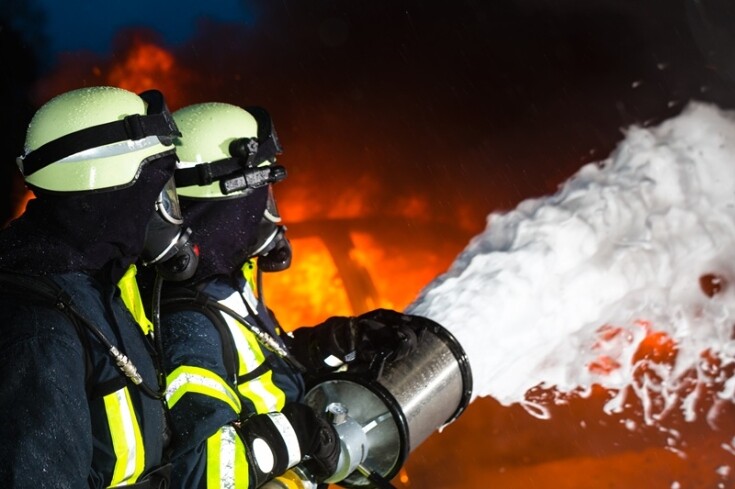
You spent years doing a dangerous job.
On base. At the airport. In industrial facilities or on the trucks in your city.
You trained with firefighting foam. You used it in live fires and drills. You got it on your skin, on your gear, in the air you breathed.
Now you have a cancer diagnosis—and questions no one has really answered:
- Was it the foam?
- Did the manufacturer or your employers know more than they said?
- Is there actually a case here, or is it just bad luck?
Meanwhile, TV ads and law-firm websites keep saying the same thing:
“If you used firefighting foam and developed cancer, call a lawyer now.”
That might get you to pick up the phone. But it doesn’t explain how a firm like Herbert Trial Law will actually try to prove that your specific exposure is connected to your specific cancer—or when an honest attorney will tell you there isn’t a case.
At Herbert Trial Law, founding attorney Kyle Herbert used to defend insurance companies and corporate defendants before switching sides. He’s seen how defense teams attack toxic-exposure claims from the inside—where they say the proof is weak, where they stall, and where they finally start paying attention.
Today, that insider perspective helps our team look at your firefighting foam story very differently from a generic intake mill.
This article walks you through what the focused firefighting foam cancer lawyers at Herbert Trial Law actually do to connect the dots between:
- The foam you used
- The places you worked
- The medical records in your file
- And the legal standards that decide whether your case moves forward
…so you can make a truth-first decision about what to do next.
Why Firefighting Foam and Cancer Are Finally in the Spotlight—and Why Herbert Trial Law Looks Deeper
For decades, aqueous film-forming foam (AFFF) was treated like a necessary tool of the job.
It worked. It put out fuel fires that water alone couldn’t touch. It was used by:
- Military firefighters on bases
- Airport fire crews
- Industrial fire brigades and refinery teams
- Municipal firefighters training on flammable-liquid scenarios
The warning labels were light. The training rarely focused on long-term health.
Only later did more information reach the public:
- Many AFFF products contained PFAS chemicals—often called “forever chemicals.”
- Those chemicals don’t easily break down and can build up in the body and environment.
- Studies began to link certain PFAS exposures with higher risks of specific cancers.
Now there are lawsuits, investigations, and national attention. But that doesn’t automatically mean every person who has ever touched foam has a clear legal claim.
That’s where the focused firefighting foam cancer lawyers at Herbert Trial Law come in—by turning headlines and science into case-level evidence for (or against) a claim.
Your Exposure Story: The Missing Link Between Foam and Diagnosis—and How Herbert Trial Law Builds It
Most people who reach out to Herbert Trial Law, regarding a firefighting foam cancer case, have two things:
- A history of working with or around firefighting foam
- A cancer diagnosis
That’s a start—but it’s not enough on its own.
What Herbert Trial Law needs is your exposure story, built out in detail. That usually includes:
1. Where You Worked and In What Role
- Military bases (branch, installation, dates of service)
- Airports or airfields (civilian or military)
- Refineries, chemical plants, or industrial facilities
- City or county fire departments
Within each location, our team wants to know:
- Your job title and duties
- Whether you were on the front line, in training roles, or both
- How often you handled foam directly versus just being nearby
2. How You Used Foam Day-to-Day
This goes far beyond “we trained with it sometimes.” Your exposure story looks at:
- Frequency of training burns and drills
- Live-fire incidents where AFFF was deployed
- How foam was mixed, sprayed, cleaned up, or disposed of
- Whether gear was repeatedly soaked in foam and then reused
Small details matter. For example:
- Did you ever work in a foam-contaminated pit or training ground?
- Did foam runoff collect where you stood, worked, or cleaned equipment?
- Were you involved in maintenance of foam systems or storage tanks?
3. What Products and Time Periods Were Involved
Different foam products—and different years—can mean different things legally.
Herbert Trial Law will dig for:
- Brand names, manufacturers, or product codes (from memory, photos, or records)
- Safety Data Sheets (SDS) or procurement documents
- When your department, base, or facility changed foam types, if ever
This helps connect where you were and what you used with what’s already known in public records and litigation about specific foams and PFAS levels.
How Herbert Trial Law Turns Your Exposure Story into Evidence
Once your exposure story and medical history are on the table, the real work begins.
Here’s how the team at Herbert Trial Law uses that information step by step.
Step 1: Map Your Work History Against Known Foam Use
At Herbert Trial Law, we don’t rely only on memory.
We use:
- Military or employment records
- Union or pension records
- Training logs and incident reports
- Public databases of PFAS contamination sites
The goal is to line up your timeline—where you served or worked, and when—with:
- Known use of AFFF products
- Documented PFAS contamination at those locations
- Prior cases or investigations involving the same bases or facilities
This is where “I used foam sometimes” becomes a documented pattern of chronic exposure.
Step 2: Connect Medical Records to the Legal Standards
Not every diagnosis is treated the same way in firefighting foam cases. Herbert Trial Law will:
- Review your full medical records, not just the discharge summary
- Confirm the type of cancer diagnosed and when it was first detected
- Look at your other risk factors (smoking history, family history, prior jobs)
Then we compare your diagnosis to what’s been recognized in current litigation and scientific literature.
The question isn’t just “Is foam dangerous?” It’s:
“Does this type of cancer, in this person, with this exposure history, meet the standards that courts and experts are already working with?”
That determines whether your case is likely to move forward—or whether a truth-first evaluation should tell you that it doesn’t.
Step 3: Identify the Right Defendants and Path for Your Case
Firefighting foam cancer cases often involve multiple manufacturers and entities, not just a single company.
Our team may:
- Identify which manufacturers made the foams used at your locations
- Determine whether your claim belongs in an existing multi-district litigation (MDL) or a separate action
- Coordinate with co-counsel or national litigation teams handling similar cases
Herbert Trial Law understands that choosing the wrong path can delay your case or weaken your position. The right path can get you into the correct track of an ongoing litigation instead of starting from scratch.
Step 4: Prepare for the Defense Playbook
Manufacturers and their insurers don’t simply accept these claims.
They may argue that:
- Your exposure was minimal or inconsistent
- Your cancer is more likely due to other risk factors
- The science isn’t as clear as you’ve been led to believe
This is where Herbert Trial Law’s insider perspective matters.
Before he switched sides, Kyle Herbert defended insurers and corporate defendants. He knows how these arguments are built—and where they’re weak. That experience informs how your case is documented from the beginning, including:
- The way your exposure story is organized
- The experts consulted
- The medical and occupational records collected
Instead of being surprised by the defense playbook, your case is prepared knowing it’s coming.
What You Should Expect from Herbert Trial Law’s Truth-First Evaluation
If you’re reading this, you’re probably not looking for a TV-style promise.
You want to know whether you really have a claim—and what happens if you don’t.
At Herbert Trial Law, a truth-first evaluation of a firefighting foam cancer case means:
- Straight answers about viability. If your exposure history or diagnosis doesn’t fit the current legal and scientific standards, we’ll tell you that rather than drag you through a process that won’t help.
- Clear explanation of next steps. If there is a path forward, we’ll explain whether your case would likely be part of broader litigation or handled another way.
- No upfront fees. Like our other injury and exposure cases, we work on a contingency basis—no win, no fee.
You’ve already carried enough risk in your career. You shouldn’t have to gamble again just to find out if you have a case.
When to Talk to Herbert Trial Law About a Firefighting Foam Cancer Case
You don’t have to have every record in hand before you reach out.
You should consider speaking with Herbert Trial Law if:
- You worked with or around firefighting foam for years, and
- You’ve been diagnosed with a cancer that might be linked to PFAS exposure, and
- You have questions about whether your employers or manufacturers knew the risks.
The earlier you get legal guidance, the sooner you can:
- Preserve important records and memories
- Avoid signing documents that limit your rights
- Understand which time limits apply to your claim
If you’re ready to talk with someone who will walk through your story and the legal standards honestly, you can learn more and reach out to the firefighting foam cancer lawyers at Herbert Trial Law here:
Firefighting Foam Cancer Lawyer – Herbert Trial Law
That page explains more about our approach to foam-related cancer cases and how to schedule a free case review.
Your Next Step with Herbert Trial Law: A Clear Path, Not Another Question Mark
Right now, you may feel like you’re stuck between two worlds:
- The world where foam was “just part of the job,” and
- The world where you have a serious diagnosis and no clear answers.
You don’t need another ad or another slogan.
You need a guide who can:
- Listen to your full exposure story
- Map it against the science and the legal standards
- Give you a clear, honest path forward—even if that means telling you not to pursue a case
That’s exactly what the team at Herbert Trial Law is here to do.
Call today to schedule a FREE case review and get a truth-first evaluation of your potential firefighting foam cancer claim.
Insurance companies and corporate defendants know how to pay you less. We know how to make them pay more—when the evidence is there. And when it isn’t, we’ll tell you that, too.
