

Preserving evidence at the scene is one of the most important steps you can take to prove the other driver was at fault and protect your financial recovery. The moments after a Houston car accident are chaotic. Your safety comes first. But once it is safe, the photos, records, and names you collect can help decide whether an insurance company pays what your car accident claim is worth or undervalues or denies it.
Evidence does not wait. Vehicles get moved, skid marks fade, dashcams overwrite, and witnesses drive away. This article explains the five kinds of evidence that matter most, what not to do at the scene, and how a lawyer can help lock down evidence you cannot reach yourself.
If you want the full timeline of what to do after a crash, see our guides to the first 24 hours and the first 72 hours after a Houston car accident.
The evidence checklist at a glance
- The official crash report. Ask for an officer to come to the scene.
- Photos and video of the vehicles, the scene, and your injuries.
- Witness names and contact information.
- Same-day medical care, even if you feel fine.
- What not to do: do not admit fault, apologize, or give a recorded statement to the other driver’s insurer.
1. Why should you call 911 and get an official police report?
Always call 911 or the local police and ask for an officer to come to the scene.
An official crash report is a third-party record of what happened. It generally records basic facts such as the drivers involved, the location, road and weather conditions, and the officer’s observations. Insurance companies often look to it, so having one gives your claim a stronger starting point.
Texas law also requires you to immediately notify police when a crash causes an injury or death, or damages a vehicle so badly that it cannot be normally and safely driven. Inside a city, that means the local police department. Outside city limits, it may be the sheriff’s office or state authorities.
Later, a person involved in the crash can buy a copy of the officer’s crash report through TxDOT’s online system. Keep the report number and the officer’s name and badge number. Remember that a police report is helpful, but it is not the final word on who is at fault.
2. What photos and videos should you take?
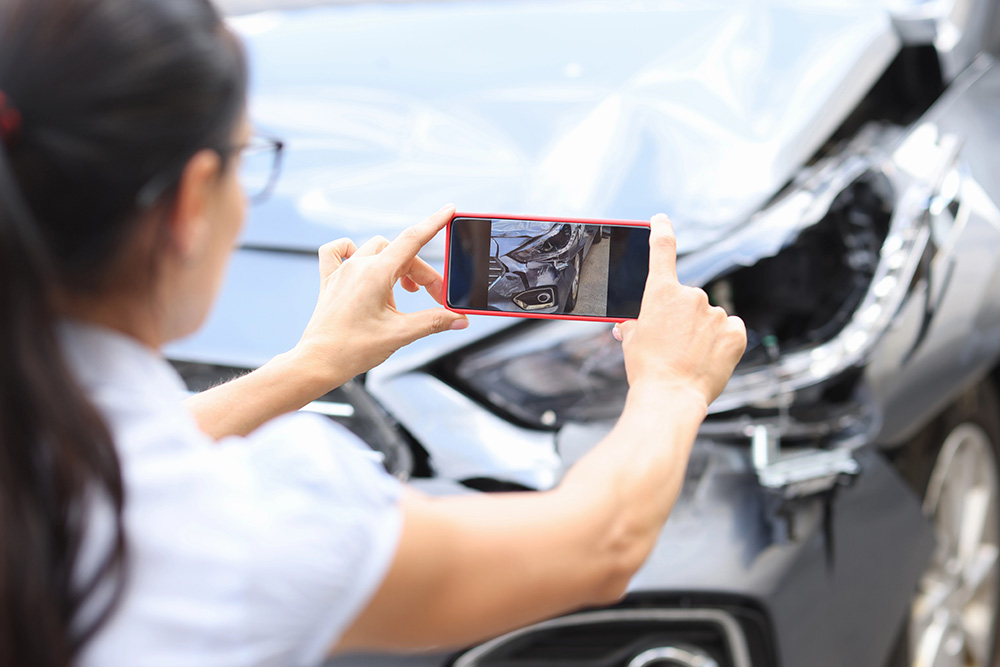
Take clear photos and videos of everything: the vehicles, the surrounding scene, and your visible injuries.
Your phone is your best tool. If it is safe, capture:
- License plates of every vehicle involved,
- Damage to all vehicles, from several angles and up close,
- Skid marks, debris, and fluid on the road,
- Traffic signs, signals, and road conditions,
- The final resting positions of the vehicles,
- The wider area, including nearby cameras, business entrances, and intersections, and
- Your visible injuries.
Take both wide shots and close-ups. Short video walk-throughs can also help. For a longer checklist, see what to photograph and save after a Houston vehicle accident.
If you have a dashcam, secure the footage right away. Many dashcams record over old video automatically, so save or copy the clip as soon as you can.
One safety note. Do not stand in traffic or put yourself at risk to take a picture. On freeways in metropolitan areas such as Houston, Texas law may also require drivers of vehicles that can still be driven to move them to a safer location as soon as possible. Take photos first only if it is safe, and otherwise take them from a safe spot as soon as you can.
3. Why do independent witnesses matter?
Collect the names, phone numbers, and emails of anyone who saw the crash.
Independent witnesses have no financial stake in the outcome. That can make their accounts more believable to insurance adjusters and, if a case goes that far, to a jury. They also matter if the other driver later changes their story.
Ask what they saw, and if they are willing, record a short voice memo or note of what they say. Do not pressure anyone. A name and a way to reach them is the most important part.
4. Why should you get medical care right away, even if you feel fine?
Seek emergency medical care immediately, even if you feel fine.
Adrenaline can mask pain after a crash. Some injuries, such as head and neck injuries, may not feel serious until hours or days later. A visit to a Houston emergency room or urgent care creates a time-stamped medical record linking your symptoms to the crash. That makes it harder for an insurance company to argue that you were hurt somewhere else or that you were not hurt at all.
Follow your provider’s instructions, keep your discharge papers, and tell the provider about every symptom, even small ones. For more on costs, see who pays medical bills after a Houston car accident.
5. What should you NOT do at the scene?
Never admit fault, apologize, or give a recorded statement to the other driver’s insurance adjuster.
In the moment, it is natural to say “I’m sorry.” But what you say at the scene can be repeated later by the other driver or their insurer. Texas law treats a simple expression of sympathy, such as “I’m sorry you’re hurt,” differently from a statement about fault. Still, it is easy for a casual apology to blur into something that sounds like blame, and defense lawyers can use that to try to shift responsibility onto you. Fault matters in Texas, and you can recover less if you are found partly at fault.
At the scene:
- Stay calm and stick to the basic facts.
- Do not guess about speed, distance, or what you “should have” done.
- Do not say you are “fine” or “not hurt” if you are unsure.
- Do not sign anything from another driver or an insurer.
When the other driver’s insurance adjuster calls, you do not have to give a recorded statement. Let an attorney handle those communications.
What evidence can disappear, and how can a lawyer help preserve it?
Some of the most important evidence is not in your hands. Business surveillance video can be recorded over. A commercial truck’s onboard data can be overwritten or lost. Other drivers’ dashcam footage may never be saved.
A lawyer can send preservation letters, sometimes called spoliation letters. These are written notices asking a driver, a company, or a business to keep specific evidence, such as:
- commercial vehicle data,
- surveillance and traffic-camera footage,
- company records, and
- other time-sensitive evidence.
The sooner they go out, the better the chance the evidence still exists.
When should you contact a Houston car accident lawyer?
It makes sense to get guidance if:
- you were hurt, or your vehicle was badly damaged,
- the other driver is blaming you or changing their story,
- a commercial vehicle or a business location was involved,
- you are being asked for a recorded statement or a release,
- you have received an early offer that feels too small, or
- you are unsure what evidence exists and who has it.
Kyle Herbert’s background on the insurance-defense side gives Herbert Trial Law a clear view of how insurers try to weaken a claim. If you were hurt in a Houston car accident, schedule a FREE Case Review with Herbert Trial Law. We can look at your situation and send preservation letters to help secure commercial vehicle data, surveillance footage, and other time-sensitive evidence.
Frequently Asked Questions
What is the most important evidence to collect after a Houston car accident?
Start with the police report, photos and video, witness contact information, and same-day medical records.
Should I call the police after a minor accident?
Yes, ask for an officer. Texas law requires you to report crashes that cause injury or death, or that damage a vehicle so it cannot be normally and safely driven.
How do I get a copy of my Houston crash report?
A person involved in the crash can purchase a copy through TxDOT’s online crash report system after the officer files it.
What photos should I take at a car accident scene?
License plates, vehicle damage, skid marks, signs and signals, the final positions of the vehicles, the wider scene, and any visible injuries.
Should I move my car before taking pictures?
Your safety comes first. On a freeway in a metropolitan area, Texas law may require you to move drivable vehicles to a safer place. Take photos first only if it is safe.
How do I save dashcam footage?
Copy or save the clip right away. Many dashcams overwrite old footage automatically.
Why do independent witnesses matter?
They have no stake in the outcome, so adjusters and juries may find them more believable.
Should I see a doctor if I feel fine?
Yes. Adrenaline can hide pain, and a prompt medical record helps connect your injuries to the crash.
Can saying “I’m sorry” hurt my case?
It can, if it blurs into a statement about fault. Stay calm, stick to facts, and avoid discussing blame.
Do I have to give the other driver’s insurer a recorded statement?
No. Get legal guidance before giving one.
What is a preservation (spoliation) letter?
A written notice asking a person or business to keep specific evidence. A lawyer can send one for commercial vehicle data, surveillance footage, and other time-sensitive evidence.
If you want help protecting the evidence in your Houston car accident, request a review with a Houston car accident lawyer o schedule a FREE Case Review.
This article is general information, not legal advice. Every case depends on its own facts.
About Kyle Herbert
Kyle Herbert is the founder of Herbert Trial Law and a former insurance defense attorney who now uses his insider knowledge to help injured Texans fight back against lowball insurance tactics. As a former Chairman of the State Bar Ethics Committee, he is known for giving clear, honest guidance to people who want to understand what their case is really worth.
